
~Maximalist art to soothe the senses~
Three years ago, my family and I went on a summer holiday to Europe, with Paris as our first stop. We only had four days in the city to cover four very different agendas, and so our itinerary was the dubious result of several tantrums and paper-thin compromises.
Something no one else wanted to do but which I refused to compromise on was sacrificing one half-day to leave Paris and visit the Palace of Versailles. I had recently become obsessed with Sofia Coppola’s resplendent Marie Antoinette (I still am), and had also just finished up a university course in French history. The idea of walking through what I had spent so much time absorbing mythic stories about had me hooked. My parents, despite their sordid past of dragging my brother and I to anything vaguely culturally relevant on every family holiday, shocked me by being completely disinterested in this piece of history. I think I remember my dad comparing it to Donald Trump’s bathroom and my mom (the artist!) complaining about the dust — to be fair to her, the palace did set off my brother’s allergies, who embellished our Versailles trip with the soundtrack of someone sneezing defeatedly every few minutes.
But as we walked through the halls, I grew deaf to all of it. Every surface around me was textured, carved, woven, painted, or embossed in some way or another. Everything — the paintings, tapestries, furniture, even the ceilings that stretched up a dozen or so feet — contained infinite details that had been painstakingly laboured over by artists hundreds of years ago. Together it all formed canopy of details and stories weaving through one another over and around our heads. I could recognize moments from Greek mythology I had read illustrated on one wall, one bed-frame contained so many minute floral patterns that it seemed to change shape right before my eyes the longer that I looked at it.
It’s not that all of this art was incredibly interesting or the awe-inspiring work of a genius, enough of it was just meant to be pretty, some of it could even have been called gaudy. But taking it all in was quieting, soothing, and revitalizing even with the crowds and mustiness; this massive riot of multi-media art had a very similar effect to that of a sensory-deprivation chamber. I couldn’t even hear the sneezes.
Overstimulated
I have a corporate job in Mumbai. I work relatively long hours, and work tends to be thrown my way in many forms; often I have to abandon what I’m currently working on to refocus on something else. It’s a jittery kind of work-life, and it probably doesn’t help that I tend to avoid the idea of using my brain when I’m on breaks, and so I spend them scrolling on Instagram, which only distracts without helping with the jitteriness — if anything, the onslaught of unrelated, superficial short-form content makes it worse. Sometimes I’m left feeling oddly shallow — as though my sentient self ends about an inch below my skin, and then there’s just rock, or metal, or maybe a vacuum. A few years ago I had read about a Frenchman who was discovered to have only about 10% of a normal adult’s brain mass, just the edges of his brain really, with cerebrospinal fluid filling the cavity. He had been living a perfectly normal life.
I always realize when my best friend is overstimulated or emotionally spent. Her conversation turns a bit hollow, her tone goes flat, I can tell there is some kind of deviation between her mind and what she’s saying. “I’m disassociated,” she admits after some wheedling. I usually manage to laugh her out of it when it happens. These are all normal side effects of the lives we have chosen for ourselves.
The Importance of Maximalism
Last weekend I went for the Art Mumbai fair with my aunt at Mumbai’s racecourse. The fair is notorious for interesting, artily dressed attendees, so I tried to dress a little more eclectically than I normally do, which for me included swapping out my usual white sneakers for strappy green sandals I stole from my mom’s closet. I was very excited. This feeling quickly waned when my Uber driver got lost finding the fair entrance and I had to get out ahead and trudge through the racecourse, dirt slipping in between the straps of my sandals and collecting uncomfortably between my toes. By the time I reached the gate and my aunt, I was sweaty, dusty and tense.
“You’re here!” She bounded up to me and gave me a big hug. One look at her and I laughed. My aunt barely clears five feet, she has a glossy crop of short black hair, a very pretty, youthful face, and generally looks a little like a pixie come to life. And today she was dressed in a men’s oversized bright teal shirt with a tie tucked into the front, all ransacked from her father’s wardrobe. She has always been a larger than life person, with aphorisms and opinions and colour bubbling over her small frame, but today that energy felt magnified and it was very hard to stay crabby around her.
She wound her arm through mine and walked me over to the galleries, where we spent as much time as we could getting lost in the art. My aunt is an artist herself and so a great person to stroll through a gallery with; we looked at the works slowly, savouring them. One painting whose name escapes me was a massive, heavily textured depiction of a human limb with some kind of hammer bearing over it and interlocking with it. I had to stand there for several minutes to feel like I had really seen it, and I still couldn’t begin to understand it. I finally stood just a couple of inches away from the canvas, right at its centre, until I felt about the size of a thumb, enveloped and swallowed up by the painting.
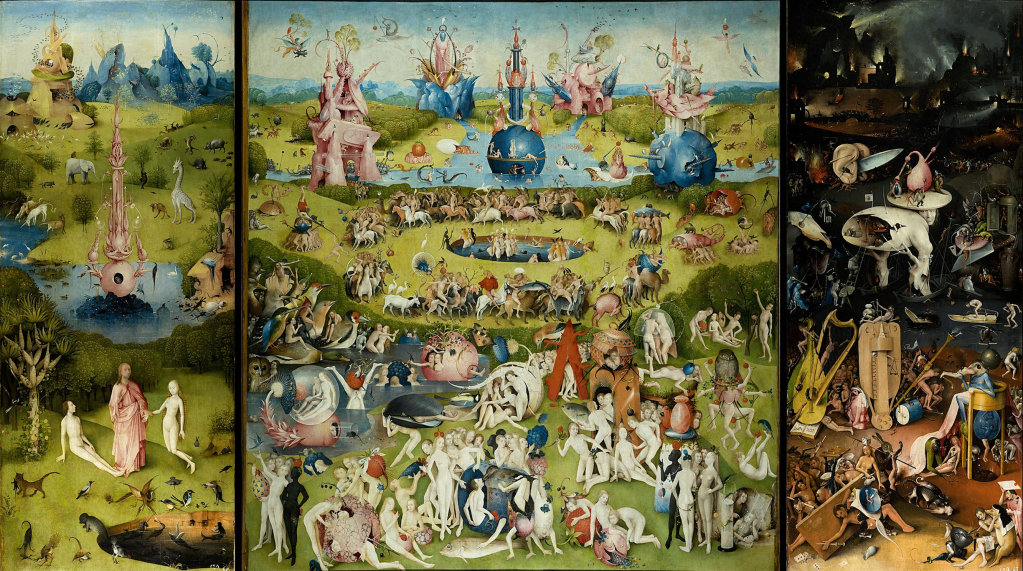
I came home that day refreshed, happier, my mind clearer than it had been in a long time, and with a renewed interest in art. My mom has a healthy collection of books on various art movements and artists and I began to parse through a couple of them, going down a rabbit hole that eventually led me to Bosch’s painting The Garden of Earthly Delights.
That painting — it’s actually three paintings, forming a triptych — is loud, kaleidoscopic, and overflowing with stuff : animals, people, monsters, fruit, flowers, all cavorting and merging in a weird kind of Bacchanalia. It’s not exactly an attractive or optimistic work — it’s rife with sexism, racism, sexual abuse, violence, religious dogma, and generally a lot of both overtly and covertly creepy imagery. But something about this work was incredibly appealing, and again I felt a little more peaceful, a little more focused as I kept looking at it, like I had felt at Art Mumbai and in Versailles — pretty much the exact opposite of the feeling I have after an hour on Instagram.
Maximalism can spark joy, that’s no secret. Being loud, bold, intricate, idiosyncratic, taking up space — it feels powerful when done well, and joyful too. This is one of the reasons why my aunt is such a joyful person in my life, and why my favourite part of getting ready to go out is putting on my rings; I have a growing collection of of weird, outsized pieces that let me turn my hands into rollicking scrapbooks.
The maximalism of these paintings, especially Bosch’s paintings, evoked a similar kind of joy, and it also did something else, which was what had engendered that feeling of calm focus. It had forced me to slow down and think. This kind of art demands to be stared at — stared at slowly, luxuriantly, and from different angles — as new thoughts and concepts and ideas emerge the longer it’s stared at. These works are not shouting opinions at you, telling you what to think, or silencing your mind entirely the way almost all the other visual content we consume does. Suddenly you feel more centred in your body, no longer just skin-deep.
I spent nearly half an hour looking at this painting and thinking — Is Bosch placing the blame for humanity’s demise more on the lasciviously portrayed Adam than on Eve? Why is sodomy via musical instrument such a mainstream aspect of hell in his mind? And why all the drugged-out looking owls? Everything there, in that cacophony of stuff, had been put down with at least some deliberation and thought; there were meanings and ideas there to be carved out — if only you could slow down to look at it.
The same is true of works by artists like Picasso and Matisse in a different way. Picasso broke up perspective, painted his subjects from all angles at once — a kind of maximalism, a sensory smorgasbord. Is anything apparent now that wouldn’t be if these perspectives were seen individually? Matisse painted the colours he saw but also the colours he felt. A double layered depiction, another kind of sensory overload — how does the colour change how we are supposed to feel about the art’s subject?

Henri Matisse, Femme au Chapeau, 1905
I’m trying to make it a part of my day now to slow down by looking at art that’s maximalist, in some way or another. It overwhelms the overstimulation right out of you.
 ketaki nair
Leave a comment